
Video Playlists
Short field videos from the OSP Hub channel, one playlist per operation.

FAHMY
Understand. Build. Deliver.
FAHMY is the centralized resource for Outside Plant (OSP) Construction and Engineering. The OSP hub for construction crews and engineers to access references, tools, interactive maps, and step-by-step SOPs for aerial, underground, and splicing.
- 38 SOP Steps
- 76 Map Parts
- 7 Field Tools
- 240 Glossary Terms
- 40 Standards
Operations
Step-by-step SOPs for each crew, from the first permit to the as-builts. Every step links to the parts on the map.
- AE Aerial
Aerial Operations
12 steps AE-01 – AE-12
- First:
- Pole Attachment Applications
- Last:
- Labeling, Inspection and As-Builts
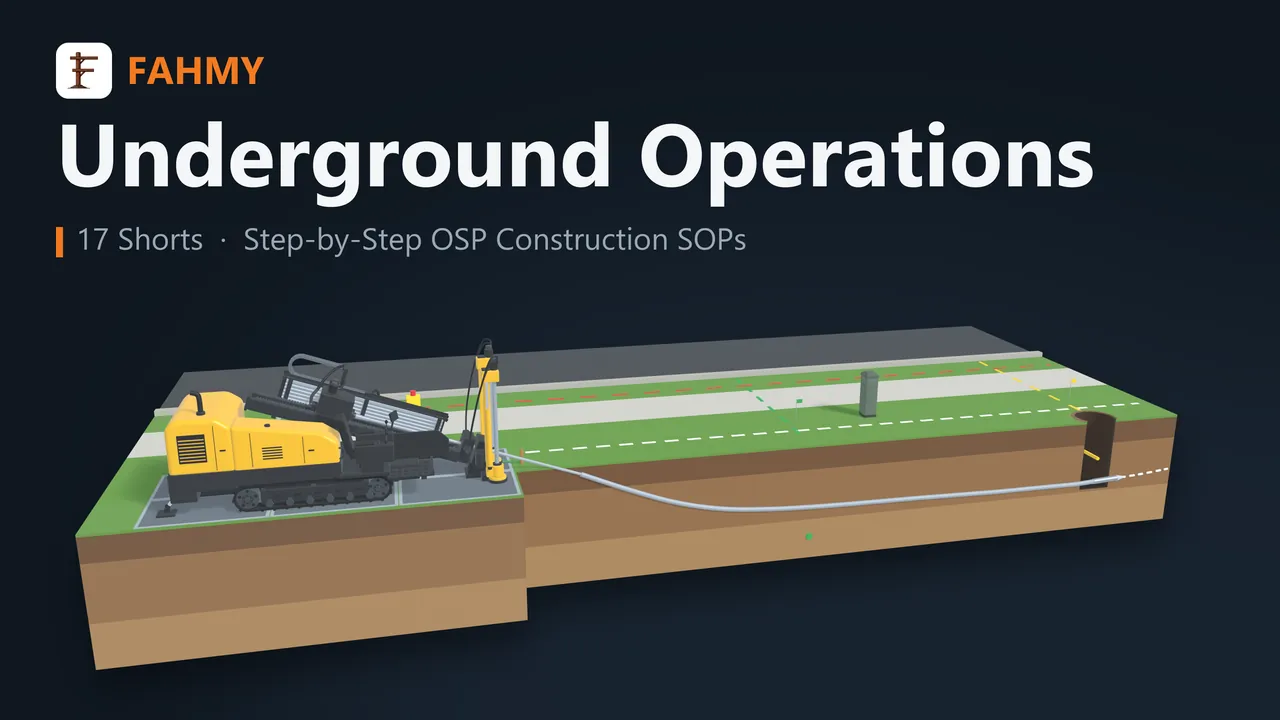
- UG Underground
Underground Operations
13 steps UG-01 – UG-13
- First:
- Permits and Right-of-Way
- Last:
- Documentation and Closeout
- SPL Splicing
Splicing Operations
13 steps SPL-01 – SPL-13
- First:
- Job Preparation
- Last:
- Emergency Restoration
Field Tools
Calculators that show their math, keep your inputs on this device and work offline.
Fiber Color Locator
Find the tube color and fiber color for a fiber number, or the fiber number for a tube and fiber color.
Optical Loss Budget
Add up optical link loss, compare it with the optics, and show headroom and loss-limited reach.
Pull Planner
Estimate cable pulling tension through straights and sweeps, compare both directions, and find a mid-route split.
Duct Fill
Check percent fill, remaining capacity and jam risk for cables in a duct.
OTDR Splice Average
Average bidirectional OTDR readings for splice loss, with pass or fail against the owner's threshold.
Cable Footage and Slack Estimator
Add up the cable a job needs (route, slack, vertical runs and tails, allowance), compare it with the reel, read the length used from the footage marks, and size slack coils.
Bore Planning Helper
Suggest a backreamer size, compute hole and pass volumes, estimate drilling fluid from the supplier's factor, and sketch the HDD entry path and setback against the first crossing.
The Lifecycle
6 stages from the first walkout to closeout, grouped as Understand, Build and Deliver. Each stage has a checklist and the mistakes that cost the most.
Understand
STA 0+00 – 1+00Build
STA 2+00 – 3+00Deliver
STA 4+00 – 5+00- STA 4+00
Splice & Test
Prove the light gets through, and keep the evidence.
10-item checklist
- STA 5+00
Close Out
Hand over records that match the field.
9-item checklist
- STA 4+00
Numbers to Know
Cited values from FAHMY's SOPs and reference. Applicable law (OSHA, your state one-call law), the authority having jurisdiction, the owner's spec and the manufacturer's data govern the job and may be stricter.
Fusion Splice Loss, Maximum
0.3 dB
Per splice. The owner’s acceptance threshold governs and may be tighter.
ANSI/TIA-568.3 SPL-07 Fusion Splicing (Single Fiber)
Bend Radius While Pulling
20 × OD under pulling tension
Minimum, in multiples of the cable OD. Use the manufacturer’s value if larger.
TIA-568.3 AE-09 Cable Placement and Lashing
Bend Radius at Rest
10 × OD at rest
Minimum once the cable is placed and at rest. Use the manufacturer’s value if larger.
TIA-568.3 AE-09 Cable Placement and Lashing
OSP Cable Tensile Rating
600 lbf (2,670 N)
Minimum rating for standard OSP cable (TIA-568.3), not a pulling limit. Drops and air-blown cable are rated lower. Set the limit for every cable from its data sheet, not from this minimum.
TIA-568.3 UG-11 Cable Placement Underground
Trench Depth That Needs a Protective System
5 feet (1.52 m)
At this depth or deeper, unless in stable rock. Shallower cuts need one too unless a competent person finds no sign of a cave-in.
OSHA 29 CFR 1926.652(a)(1) UG-04 Potholing (Daylighting)
Spoils Back from the Trench Edge
2 feet (0.61 m)
Minimum for spoils and equipment, or use retaining devices.
OSHA 29 CFR 1926.651(j)(2) UG-04 Potholing (Daylighting)
Treat Power Fixtures as Energized
20 in
Metal power conduit, exposed vertical ground wires and streetlights below the comm attachments, or less than this above them. Test for voltage unless visibly bonded to the strand.
29 CFR 1910.268(m)(3)(i) AE-04 Site Safety and Traffic Control for Aerial Work
Tolerance Zone Where Law Is Silent
18 in (450 mm)
APWA guideline: facility width plus this, measured from each outside edge of the facility, not from the paint. Your state one-call law governs and may differ.
APWA Guidelines for Uniform Temporary Marking of Underground Facilities APWA Uniform Color Code
APWA Uniform Color Code
Why Orange?
Orange marks communication lines, so it is the color of what OSP crews build.
Read a marked site- Orange Communication, alarm or signal lines, cables or conduit
- Red Electric power lines, cables, conduit and lighting cables
- Yellow Gas, oil, steam, petroleum or gaseous materials
- Blue Potable water
- Green Sewers and drain lines
- Purple Reclaimed water, irrigation and slurry lines
- Pink Temporary survey markings
- White Proposed excavation
Coming to FAHMY
What the hub has added since version 2 and what is planned next. Planned items may change.
- Pole Loading Primer Available
- Make-Ready Tracker needs accounts and a backendPlanned
- Permit Directory by State Available
- OTDR Trace Reader Available
- Downloadable Templates SOW, BOM, tailboard, punch list, closeout packageAvailable
- Community Q&A Planned
- Spanish Edition Planned
- Cable Footage and Slack Estimator Available
- Bore Planning Helper Available